Do You Need a Survey to Sell a House in Ohio?
Sellers often ask whether they need to order a land survey before selling. The rules we read do not put that duty on the seller. But a buyer, a lender or your purchase contract may ask for one, and some problems only a survey can answer. Here is what Ohio law says about who can survey and what a boundary survey must contain.
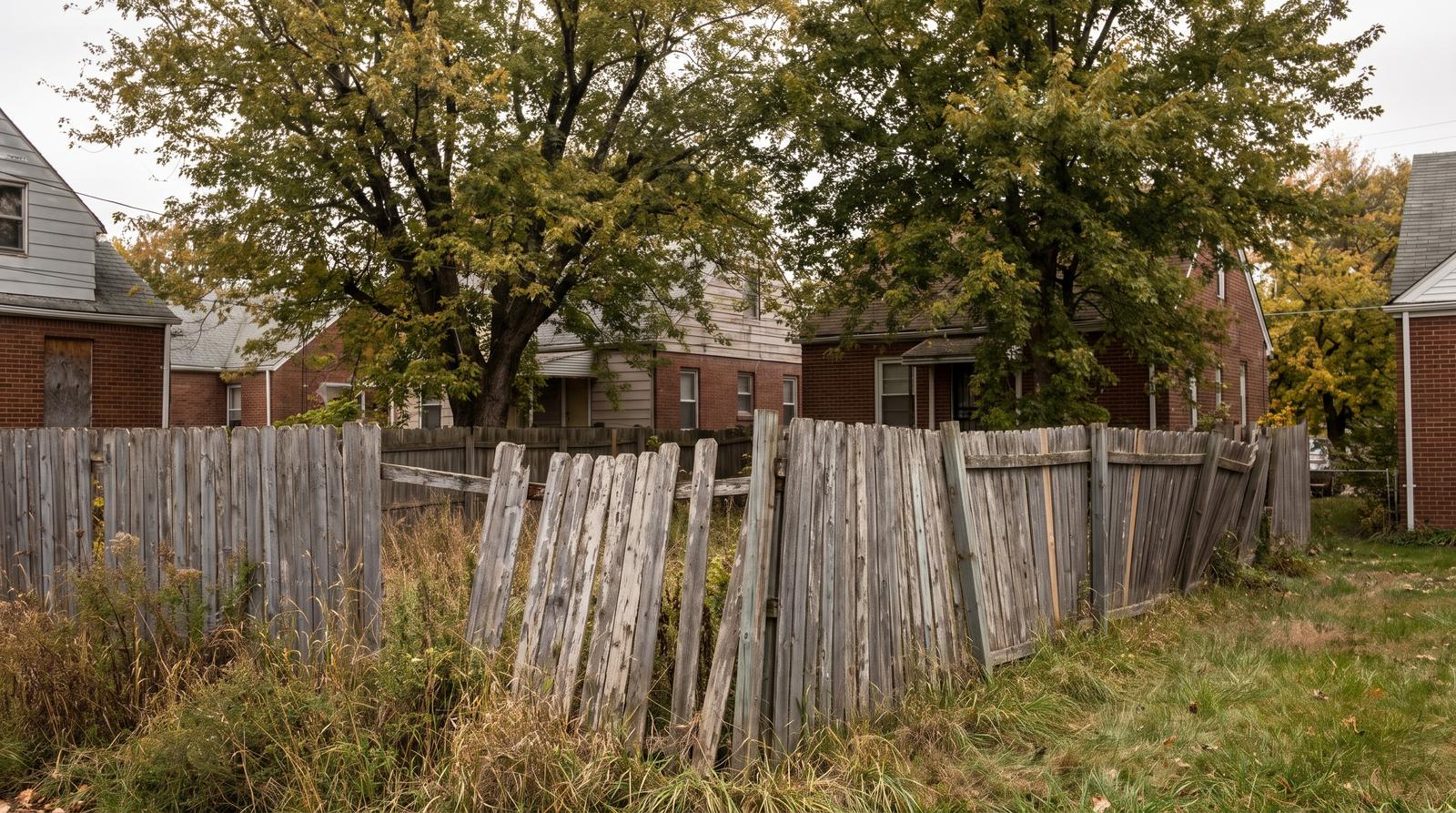
A side yard between two older houses on an autumn morning with a weathered wooden privacy fence along the line, orange ribbon tied to a fence post and a garage behind
The Ohio surveying rules we read do not require a seller to order a survey. A sale can often use the legal description already in the deed. But a buyer, lender or contract can ask for one, and a survey is the tool for fence disputes, unclear lines or a new description. In Ohio, only a registered or exempted surveyor may do the work, and the state sets standards for what a boundary survey includes.
When a survey comes up in a sale
- The purchase contract says the buyer may get a survey, or that the seller will provide one.
- The buyer's lender or title company asks for one.
- A fence, driveway or shed may sit over the line.
- The lot is being split, or a new legal description is needed.
- Old corner markers are missing and nobody is sure where the line runs.
We will not quote what a survey costs or how long it takes. Prices and timing vary with the lot and the records, and we have not verified a current figure. Ask a registered surveyor for a written quote.
Not sure where your lines are?
Send us the address. We buy houses as-is and can work through boundary questions with the title company.
Who can survey land in Ohio
ORC 4733.02 says anyone practicing or offering to practice surveying must be registered or exempted under Ohio law. No one may use the initials "P.S." or present themselves as a professional surveyor unless registered or exempted. Under ORC 4733.01, the practice of surveying includes measuring property lines for their correct description and for conveyancing and recording. Ask for the surveyor's Ohio registration number. Under the standards, it also goes on the monuments they set, when practicable, and on any new description they write.
What an Ohio boundary survey must include
The Ohio Administrative Code, Chapter 4733-37, sets minimum standards for every survey that establishes or retraces property boundaries in Ohio. Stricter local rules also apply where they exist.
| Step | What the standards say | Rule |
|---|---|---|
| Research | Consult deeds and other documents, including for neighboring parcels | 4733-37-02(A) |
| Field work | Search for monuments, review evidence of occupation, confer with owners when necessary | 4733-37-02(B) |
| Monuments | Set a monument at each corner, or a reference monument when a corner cannot be set | 4733-37-03 |
| Accuracy | Error no more than 1 in 10,000, or 0.02 feet for distances under 200 feet | 4733-37-04 |
| Drawing | A scale drawing for every boundary survey, with a copy to the client | 4733-37-05 |
Summarized from OAC 4733-37 as we read it. A surveyor may abridge a provision for local conditions, but must clearly note it on the plat or description.

The markers at your corners
OAC 4733-37-03 says that, when practicable, each monument a surveyor sets should be made of durable material, be at least 30 inches long and at least 0.21 square inches across, carry a marker with the surveyor's Ohio registration number or name, and be detectable with instruments that find iron or magnetic objects.
When a corner falls inside a tree, a building or water, the surveyor sets a reference monument nearby and labels it on the plat. Where pavement or rock blocks a monument, an alternative mark such as a chiseled "X" or a drill hole may be used and noted.
What you get when it is done
Under OAC 4733-37-05, the surveyor prepares a scale drawing of every survey that retraces or establishes property lines and gives you a copy. The drawing shows, among other things:
- A title identifying the state, county and municipality or township.
- A north arrow and the basis for directions.
- Whether each corner monument was found or set, with its size and material.
- Evidence of occupation along every boundary line, such as fences or walls.
- The length and direction of each line, and the sources used.
OAC 4733-37-06(E) says that when a surveyor knows a new description will be used for a transfer of ownership, the description must be based on a current or updated survey. If your sale needs a new legal description, plan for survey work.
What a new legal description must say
Sometimes a sale needs a new written description of the land, for example when an old one is unclear. OAC 4733-37-06(A) says a new description written by a surveyor must include:
- A caption that identifies the property.
- How the property relates to clearly defined control points.
- The basis used for directions.
- A citation to the recorded prior deed or deeds.
- The surveyor's name, Ohio registration number and the date.
Under OAC 4733-37-06(D), the description must also say whether it was based on a recent survey, a previous survey, or no survey at all. That one line tells a buyer and a title company how much field work stands behind the words.
Common situations
The fence has stood for decades but may be off the line
A survey drawing notes evidence of occupation, like fences, along each boundary line. It can show whether the fence sits where the deed says the line is. If it does not, our post on Ohio title problems and quiet title covers the tools for fixing a title.
Nobody can find the corner markers
The standards call for a thorough search for physical monuments during the field work. If an old corner cannot be found, the surveyor works from the deeds, neighboring records and other evidence, then sets new monuments so every corner is marked when the survey is done.
Your neighbor sees someone measuring in the yard
Under OAC 4733-37-02(B), the surveyor confers with the owners of adjoining property when necessary. A quick note to your neighbor before the visit can head off worry.
You only care about one side of the lot
OAC 4733-37-01 lets a client have only a portion surveyed, if that portion can be clearly separated from the rest without affecting the neighbors' interests.
Know your net proceeds
If your contract makes you pay for a survey, count it as a selling cost. With made-up numbers, a $140,000 house listed with a 6% commission pays $8,400 to agents, plus closing costs, any survey or repairs, and holding costs. A direct sale has no commission, but the offer is often lower than a top listing price. Compare the full net each way. A cash sale does not always net more.
Your six options
| Option | Survey angle | What to weigh |
|---|---|---|
| Keep it | Survey only if a line question comes up | Ongoing costs |
| Repair it | Fences or sheds near a line may need one first | Cash and time up front |
| Rent it out | Rarely needed | Landlord duties |
| List with an agent | Depends on the contract and the buyer's lender | Commissions often run 5.5% to 6% |
| Sell it yourself (FSBO) | You negotiate who pays if one is needed | More work for you |
| Sell direct for cash | Ask whether the buyer wants one | As fast as 7 days, typically around 21. The price is often lower |
Read your purchase contract to see who orders and pays for any survey.
Compare an as-is offer
We buy houses across Cleveland and Northeast Ohio, boundary questions and all. Ask for a written number and compare your net.
This article summarizes Ohio Revised Code 4733.01 and 4733.02 and Ohio Administrative Code 4733-37 as we read them in November 2026. It is general information, not legal advice. We did not cover survey prices, title insurance survey terms or lender requirements. Talk to a registered surveyor, title company or Ohio real estate attorney about your property.
Questions about your property lines?
Call or send us the address. We will walk you through a direct sale, and the decision stays yours.
Frequently asked questions
The surveying rules we read do not put a duty on sellers to order a survey. A buyer, lender or purchase contract may still ask for one. Check your contract and ask your title company.
A person practicing or offering to practice surveying must be registered or exempted under Ohio law. No one may use "P.S." or claim to be a professional surveyor unless registered or exempted.
Research of deeds, including neighboring parcels, a field search for monuments, monuments set at the corners, measurements meeting accuracy standards, and a scale drawing given to the client.
Ohio standards call for monuments at each corner that, when practicable, are durable, at least 30 inches long, marked with the surveyor's registration number or name, and detectable with metal-finding instruments.
When necessary, the surveyor confers with the owners of the adjoining property as well as the owners of the property being surveyed.
Yes, if that portion can be clearly separated from the rest without affecting the neighbors' interests.
When a surveyor knows a new description will be used for a transfer of ownership, it must be based on a current or updated survey.
Find out what we would pay
Free, no obligation, and no pressure. If our number does not work for you, that is a perfectly fine answer.
Keep reading
Liens, Taxes & Title
A Problem With the Title: Affidavit or Lawsuit?
Ohio has a cheap recorded affidavit for gaps in the record and a court action for genuine adverse claims. Using the wrong one wastes months.
Liens, Taxes & Title
Old Deed Restrictions in Ohio: The 40-Year Marketable Title Act
An old deed restriction or a forgotten easement can worry a buyer. Ohio's Marketable Title Act clears many claims older than a 40-year root of title, with key exceptions.

Liens, Taxes & Title
A Mistake in an Old Deed? Ohio's Four-Year Cure Rule
A missing witness, a notary seal that was never stamped or a signer left out of the wording can worry a buyer. Ohio law cures many of these deed mistakes after four years.