Short Sale or Deed in Lieu in 2026? The Tax on Forgiven Mortgage Debt
For years, a homeowner who lost a house in a short sale or foreclosure could usually leave the forgiven mortgage debt off their tax return. That rule had an end date, and Congress moved it many times. As of today, the law says it ended for debt forgiven after December 31, 2025. If you are underwater in Ohio and thinking about a short sale or deed in lieu, the tax side now deserves a real look before you sign.
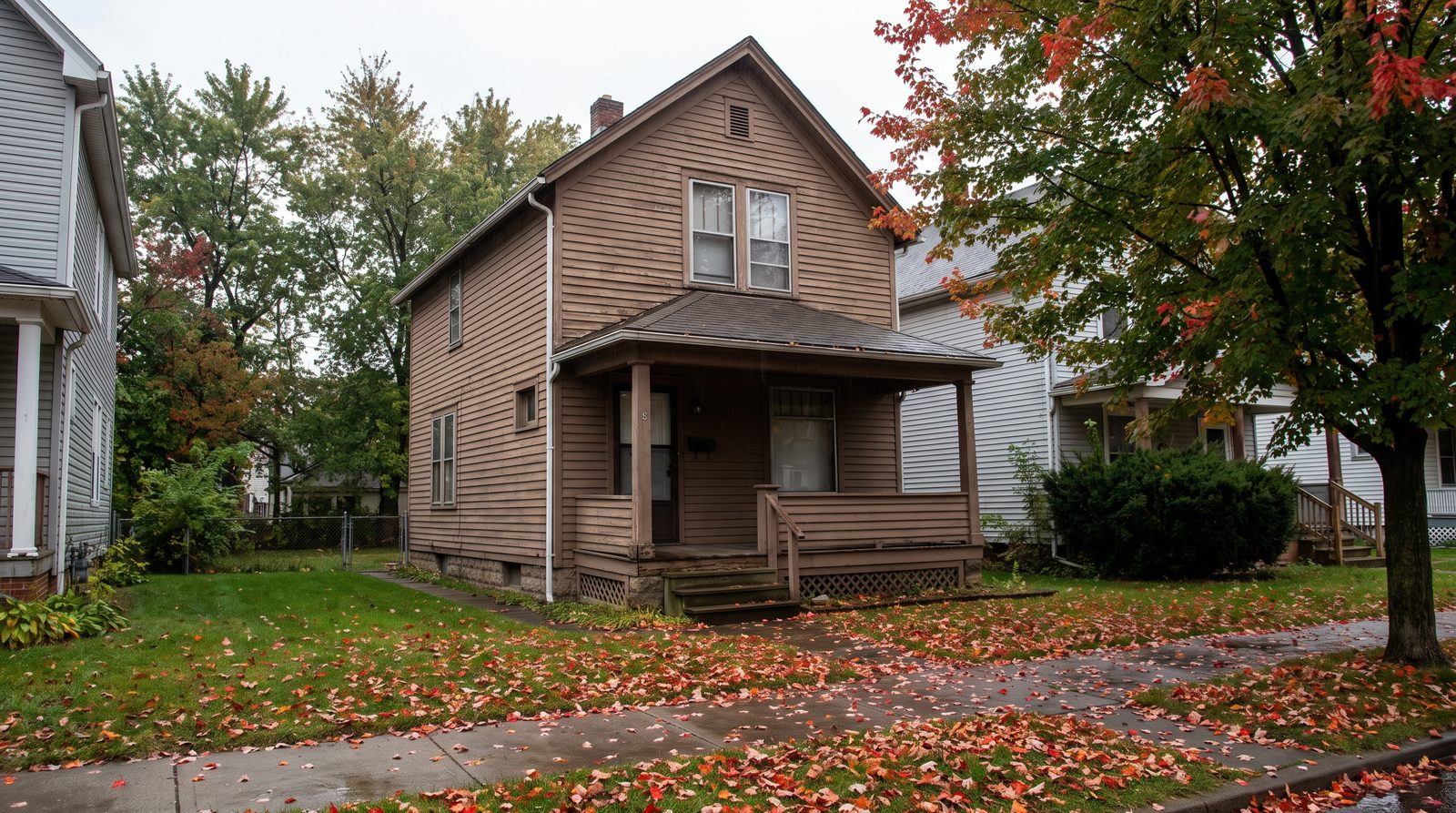
A vacant brick bungalow at dusk in late autumn with an empty driveway, fallen leaves, a downed branch and an overcast sky
When a lender forgives part of your mortgage in a short sale, deed in lieu or foreclosure, the forgiven amount is generally treated as income. The special break for a main home only covers debt forgiven before January 1, 2026, or under a written agreement signed before then. For debt forgiven later, you may still qualify for the bankruptcy or insolvency exclusion. Talk to a tax professional before you sign with the lender, not after the form arrives.
Why forgiven debt counts as income
Federal tax law lists "income from discharge of indebtedness" as part of gross income. The idea is simple. You borrowed money and did not pay tax on it because you were supposed to pay it back. If the lender lets you off the hook for part of it, the IRS treats the part you never repay as if you received it.
In a home sale, this comes up when the lender accepts less than you owe. A short sale for less than the payoff, a deed in lieu that hands the house back, or a foreclosure that leaves a balance the lender later writes off can all create canceled debt. If the house sells for enough to pay the loan in full, no debt is canceled, and this whole issue goes away.
One thing surprises people. The IRS says you must report canceled debt even if you never get a Form 1099-C, unless an exception or exclusion applies. The form is a reporting tool for the lender. It is not what makes the income real.
Reading a Form 1099-C
Federal law requires a lender that is an "applicable entity" to report a discharge of $600 or more to the IRS and to send you a statement. That is usually a Form 1099-C. Two boxes matter most for homeowners.
- Box 2, the amount. The IRS says this may include principal and may also include interest and other amounts such as fees or penalties. Check it against your payoff statement and your closing paperwork.
- Box 6, the reason code. Code A means bankruptcy. Code B covers a foreclosure or similar court proceeding other than bankruptcy. Code C covers the end of a statute of limitations or of the period to start a deficiency proceeding.
If the numbers look wrong, ask the lender to correct the form before you file. A wrong form is easier to fix early than to explain later.
What changed on January 1, 2026
For years, Congress has allowed homeowners to exclude forgiven debt on their main home, called qualified principal residence indebtedness. It was always temporary and was extended many times. The current statute says it covers debt discharged before January 1, 2026, or discharged under an arrangement entered into and evidenced in writing before January 1, 2026.
The IRS put it plainly in its 2025 guide to canceled debts: this debt "cannot be excluded from income for discharges completed or discharge agreements entered into after December 31, 2025." The 2025 tax law changed other parts of the same section but left that date alone. Congress has revived this break after it lapsed before. We are not going to predict whether it will again. Plan around the law as written today.
| When the debt was forgiven | Main-home exclusion available? | Source |
|---|---|---|
| Before January 1, 2026 | Yes, if the debt qualifies, up to $750,000 ($375,000 if married filing separately) | 26 USC 108(a)(1)(E)(i), (h)(2) |
| On or after January 1, 2026, under a written arrangement entered into before that date | Yes, if the debt qualifies | 26 USC 108(a)(1)(E)(ii) |
| On or after January 1, 2026, with no qualifying earlier written arrangement | No. Look at the bankruptcy and insolvency exclusions instead | IRS Publication 4681 (2025), What's New |
Qualified principal residence indebtedness means debt used to buy, build or substantially improve your main home and secured by it. Money you took out for other things, such as paying off credit cards, does not count. The IRS also says the exclusion does not apply if the debt was canceled for services you performed or for a reason not directly related to a drop in your home's value or your finances.
Not sure if you are underwater?
Send us the address. We will give you a no-obligation cash offer so you can compare it with your payoff. If you have equity, a full payoff means no forgiven debt at all.
The exclusions that still exist
The end of the main-home break does not mean every dollar of forgiven debt is taxed. Two older exclusions are still in the law.
- Bankruptcy. Debt discharged in a title 11 bankruptcy case is excluded from income. The law says this exclusion takes priority over the others.
- Insolvency. If your total debts were more than the fair market value of everything you owned immediately before the debt was canceled, you were insolvent. You can exclude canceled debt up to the amount by which you were insolvent, and no more.
Both are claimed on Form 982, attached to your federal return. Both can also require you to reduce certain "tax attributes," such as loss carryovers or the basis of property you keep. The IRS publication includes an insolvency worksheet that lists the kinds of debts and assets to count. A homeowner who is far enough underwater to need a short sale is sometimes insolvent, but not always. Retirement accounts and other assets count on the asset side. Do the worksheet with a tax professional instead of guessing.

Short sale, deed in lieu and foreclosure, compared
How the IRS measures the forgiven amount depends partly on whether you were personally liable for the loan. A loan you are personally on the hook for is called recourse debt. A loan where the lender can only take the property is nonrecourse debt.
- Recourse debt. In a foreclosure or similar transfer, your canceled-debt income is generally the outstanding debt minus the property's fair market value. The fair market value part is treated as what you got for the house.
- Nonrecourse debt. The IRS counts the full outstanding debt as part of the amount you realized on the transfer, even if the house was worth less.
- Deed in lieu. The IRS says handing the house to the lender instead of a foreclosure is not an abandonment. It is treated as an exchange of the property to satisfy the debt.
- A loss on your home. In the IRS's own example of a foreclosed home that brought less than the owner's basis, the loss was nondeductible.
Say you owe $150,000 on a recourse loan. Your lender approves a short sale, receives $120,000 after closing costs, and forgives the rest. The canceled debt is the $30,000 gap, plus anything else the lender writes off, such as fees. In 2026, unless you had a qualifying written arrangement before January 1 or you qualify for bankruptcy or insolvency treatment, that forgiven amount may be ordinary income. These numbers are invented to show the steps, not drawn from any real sale.
The Ohio side
Ohio's income tax starts from your federal adjusted gross income. So canceled debt that ends up in your federal income usually flows into the starting point of your Ohio return as well. Ohio has its own list of adjustments, and we did not research how any of them might apply to canceled debt. Ask your tax preparer.
Ohio law also limits deficiency judgments after a foreclosure. Under ORC 2329.08, a money judgment on a mortgage for a one- or two-family home becomes unenforceable as to any deficiency two years after the judicial sale is confirmed, with some exceptions. That rule is about collecting the debt, not about taxes. But the IRS lists the expiration of a deficiency period as one of the events that can lead a lender to report canceled debt. Our post on owing more than your house is worth explains why a short sale does not come with that same two-year limit.
Your six options, with the tax side in mind
| Option | Canceled debt? | What to weigh |
|---|---|---|
| Keep it | No, as long as you keep paying. A loan modification that cuts principal can be canceled debt | Whether you can afford the payment for the long haul |
| Repair it | No, by itself | Repairs cost money up front and may not close the gap if you are underwater |
| Rent it out | No, by itself | Rent has to cover the mortgage, taxes, insurance and upkeep |
| List with an agent | Only if the price does not cover the payoff and the lender forgives the rest | Commissions often run 5.5% to 6%, which comes out of what is left for the loan |
| Sell it yourself (FSBO) | Same as listing | No commission, but you handle marketing, showings and paperwork |
| Sell direct for cash | Only if the price does not cover the payoff and the lender forgives the rest | Speed and an as-is sale. A short sale still needs the lender's approval |
If any sale leaves a gap, ask the lender in writing whether the balance will be forgiven or whether you will still owe it. Forgiven debt can be income. Debt you still owe is a bill. Neither is good news, but they are different problems.
See your real net before you decide
We will put a written cash offer next to your payoff and a listing estimate, with commissions counted. If you have equity, you keep it. If you do not, we will say so plainly and you can take the numbers to your tax pro.
What to do before you sign with your lender
Get a written payoff
Find out if there is a gap at all
Ask the lender what happens to the balance
Gather your dates
Run the insolvency worksheet with a tax pro
Plan for the form
This article summarizes 26 U.S.C. §§ 61, 108 and 6050P, IRS Publication 4681 (2025), and Ohio Revised Code §§ 5747.01 and 2329.08 as we read them in October 2026. It is general information, not tax or legal advice. Tax law can change, and Congress has extended this exclusion retroactively before. Talk to a CPA, enrolled agent or tax attorney about your own situation before you agree to a short sale, a deed in lieu or a loan modification.
Questions about selling an underwater house?
Call or send us the address. We will walk through your payoff, your options and where a cash sale fits, with no pressure and no obligation.
Frequently asked questions
It can be. Canceled debt is generally treated as income. The special exclusion for forgiven debt on a main home covers discharges before January 1, 2026, or under a written arrangement entered into before that date. The IRS says it cannot be used for discharges completed or agreements entered into after December 31, 2025. Other exclusions, such as bankruptcy and insolvency, still exist.
The statute also covers debt discharged under an arrangement that was entered into and evidenced in writing before January 1, 2026. Whether your paperwork counts is a question for a tax professional, so bring them every document you signed with the lender and the dates.
A lender that is an applicable entity must report a discharge of $600 or more and send you a statement. That form is usually a 1099-C. But the IRS says you must report canceled debt even if you do not receive one, unless an exception or exclusion applies.
You can exclude canceled debt to the extent you were insolvent immediately before the cancellation. Insolvent means your total debts were more than the fair market value of everything you owned. The exclusion is capped at the amount by which you were insolvent. It is claimed on Form 982.
Debt discharged in a title 11 bankruptcy case is excluded from income, and that exclusion takes priority over the others. You may have to reduce certain tax attributes afterward. Ask your bankruptcy attorney and a tax professional together.
No. The IRS says a voluntary conveyance of the property in lieu of foreclosure is not an abandonment. It is treated as an exchange of the property to satisfy a debt.
Yes. If you were personally liable (recourse debt), canceled-debt income generally equals the debt minus the property's fair market value. If you were not personally liable (nonrecourse debt), the IRS counts the full outstanding debt as part of what you realized on the transfer.
Ohio's income tax starts from your federal adjusted gross income. So canceled debt that is included in your federal income usually carries into the Ohio starting point. Ohio has its own adjustments, so ask a tax professional about your return.
No debt is canceled when the loan is paid in full at closing. Canceled-debt income comes up when a lender accepts less than what you owe, as in a short sale, a deed in lieu or a foreclosure that leaves a balance unpaid.
Find out what we would pay
Free, no obligation, and no pressure. If our number does not work for you, that is a perfectly fine answer.
Keep reading

Foreclosure & Hardship
What Happens If I Owe More on My Mortgage Than My Cleveland House Is Worth?
Being underwater is a problem with routes out of it. Ohio puts a two-year limit on a deficiency after a judicial sale — but not after a short sale.

Foreclosure & Hardship
Can I Sell My House Before Foreclosure in Cleveland, Ohio?
Yes — and the window is usually longer than people think. Under Ohio law the right to redeem runs until the court confirms the sale, not until the sheriff sale itself.
Foreclosure & Hardship
Selling Your House During Chapter 13 Bankruptcy in Ohio
You can sell a house while your Chapter 13 case is open, but the court usually has a say. Here is how the notice, hearing and waiting periods work, and what happens to the money.