When a Court Puts Your House in Receivership
There is a provision in Ohio law that lets somebody else take control of your building, fix it, and charge the cost against the property ahead of every other lien including the taxes. It is real and it is used in Cleveland. It also has a definition at the top that puts most owner-occupied homes outside it completely, and a set of steps that have to happen first.
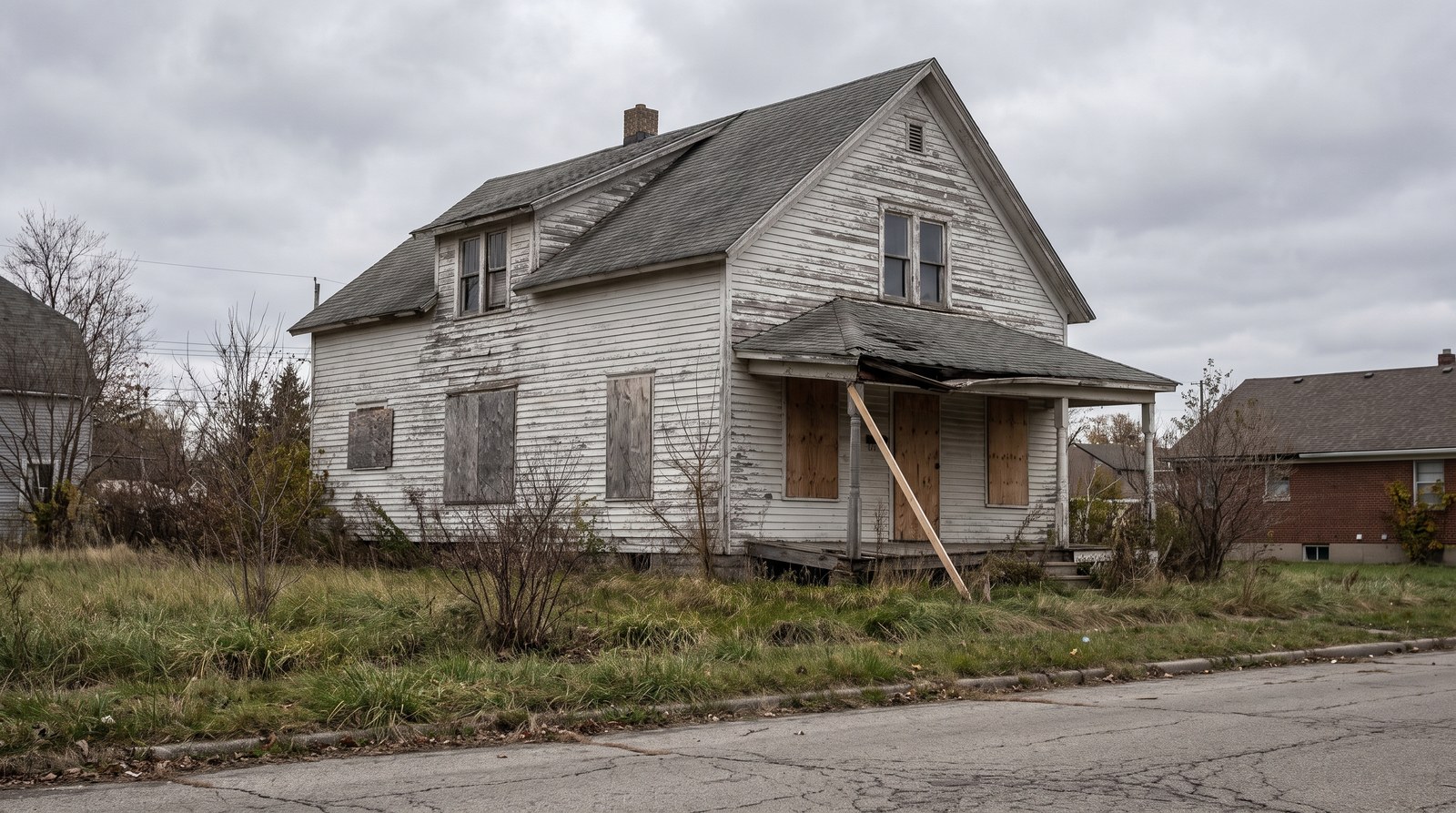
The rear of an older two-family wooden house with a sagging back porch, weathered stair landings and peeling paint
Ohio allows a city or township, a neighbour, a tenant, or a housing nonprofit to ask a court to declare a building a public nuisance and, in the right circumstances, appoint a receiver to fix it. The cost becomes a first lien that outranks everything, including taxes. But the section defines "building" to exclude anything occupied by its owner with three or fewer residential units — so an owner-occupied house, double or triple is outside it.
Most owners will never meet this provision, and it is not something that lands without warning. It is worth understanding anyway, because it is the mechanism sitting behind a lot of vague advice about deteriorating rentals and vacant properties in Cleveland — and because the money consequences are unusually severe when it does run its course.
The definition that decides whether any of this applies
Start at the top of the section, because the definition does a lot of work. A "building" here means a building or structure used or intended to be used for residential purposes — including a mixed building with shops or offices on one floor and residential use on others.
Then comes the sentence that matters most to the average reader: "Building" does not include any building or structure that is occupied by its owner and that contains three or fewer residential units.
Both halves have to be true. Occupied by its owner, and three or fewer residential units. A house you live in, a double where you occupy one side, a triple where you live in one unit — outside the section. A vacant house, a rental you do not live in, or a four-unit building is not excluded by that sentence, whoever owns it.
What counts as a public nuisance
The statute gives a definition rather than leaving it to argument. A public nuisance is a building that is:
- A menace to the public health, welfare, or safety;
- Structurally unsafe, unsanitary, or not provided with adequate safe egress;
- A fire hazard, otherwise dangerous to human life, or otherwise no longer fit and habitable; or
- In relation to its existing use, a hazard to the public health, welfare, or safety by reason of inadequate maintenance, dilapidation, obsolescence, or abandonment.
There is a separate and more detailed standard for subsidized housing, keyed to federal regulations. We have not read those regulations, so we are not describing what they require beyond noting that a different test applies there.
Who can bring the case
This surprises owners more than anything else in the section. The action may be commenced by the municipal corporation or township where the building is located — but also by any neighbour, by a tenant, or by a nonprofit corporation that is duly organised and has the improvement of housing conditions in that county or municipality as one of its goals.
It can be filed in a court of common pleas, a municipal court, a county court, or the housing or environmental division of a municipal court — which is the venue that matters locally, because Cleveland has one.
And there is a sentence that explains why these cases get filed at all: the party commencing the action is not liable for the costs, expenses, and fees of any receiver appointed. The complainant is not taking on the repair bill. The property is.
Worried a property is heading this way?
Tell us what notices you have had and what condition the building is in. We will give you an honest read on where it sits — including when the sensible answer is to repair it and keep it, which is often the case.
What the judge has to find first
A finding that the building is a public nuisance is not by itself enough for this relief. The statute requires the judge to additionally determine that the owner of the building previously has been afforded a reasonable opportunity to abate the public nuisance and has refused or failed to do so.
That is the protection worth knowing about, and it is why a receivership is not something that appears out of nowhere. There is a served complaint, a hearing with a date and time, and a requirement that you were already given a chance and did not take it.

Lienholders get first refusal
Before appointing an outside receiver, the judge must offer any mortgagee, lienholder or other interested party, in the order of the priority of interest in title, the opportunity to undertake the work and furnish the materials to abate the nuisance.
It is not a formality for them either. Before selecting an interested party, the judge must require them to demonstrate the ability to promptly do the work and supply the materials, to provide a viable financial and construction plan for the rehabilitation, and to post security.
The lien that outranks the taxes
Here is the part that changes the arithmetic on a property completely, and it is stated in the statute in the plainest possible terms.
Expenditures to abate the nuisance, and expenditures in connection with foreclosing the lien, are a first lien upon the building and the property on which it is located, and superior to all prior and subsequent liens or other encumbrances associated with the building or the property — including, but not limited to, those for taxes and assessments.
What has to happen before that lien attaches
| Condition | What the statute requires |
|---|---|
| Judicial approval | Prior approval of the expenditures by the judge in the civil action, and the entry of a judgment to that effect. |
| Recording, on a clock | Recordation of a certified copy of the judgment entry, with a sufficient description of the property, with the county recorder in the county where the property is located — within sixty days after the date the judgment was entered. |
| What else it covers | The same treatment extends to a receiver’s expenses, any notes the receiver issues, mortgages the receiver grants, and the receiver’s fees as approved by the court. |
Summarised from ORC 3767.41(C)(2)(a) and (b). Both conditions are required for the first-lien status — the judgment alone does not do it, and neither does work done without prior approval.
A receiver’s own fees are payable in the same manner and to the same extent as receivers appointed in mortgage foreclosure actions, limited by the income the property produces. That limitation matters: a property producing no income does not generate fees out of thin air, but the abatement costs still attach to the property.
Want to know what the property is actually worth like this?
We will look at a building in any condition and give you a written number, then set it beside what a listed sale or a repair-and-hold would net. The comparison is the useful part, whichever way it points.
How it ends
A receivership is not permanent, but the exit conditions are demanding. The receiver is discharged when all of the following have happened: the public nuisance has been abated; all costs, expenses and approved fees of the receivership have been paid; and either all the receiver’s notes and mortgages have been paid, or the holders of them request otherwise.
The other route is a sale. The judge may order the building and the property sold on terms the court specifies, with the receiver distributing the proceeds and the balance of any funds after the costs of sale. We have not read the foreclosure and sale mechanics to their end, so we will say only that the power exists rather than describing how a sale plays out.
Your options, honestly
Keep it and abate the condition
Far and away the most common outcome, and the one the statute is designed to produce. The judge has to find you were already given a reasonable opportunity and did not take it — so taking it is the answer to this entire article.
Repair, then decide
If the problem is a roof, a porch or an open building rather than the whole structure, fixing the specific condition removes the ground for an action and leaves your choices open.
Rent it out once it is sound
Worth noting that a tenant is among the people who may commence one of these actions. A building in good repair is not exposed to that; a neglected one is.
List it with an agent
Entirely possible, though a building with an open nuisance case will be priced accordingly. Commissions in our area commonly run 5.5% to 6%, and any lien on the property is settled from the proceeds.
Sell it yourself
Workable, but disclose what you know and expect a buyer’s title search to surface anything recorded. A recorded judgment entry under this section is not something that stays quiet.
Sell direct for cash
Realistic where the repairs are beyond what you want to take on and the building is not one you live in. We can close as fast as seven days where circumstances allow, though a typical close runs about 21 days. It is not automatically the best net — compare it against repairing and keeping.
We are not going to tell you how many of these cases are filed in Cuyahoga County, because we have no source we can read. We are not quoting receiver fees, abatement costs or filing fees for the same reason. And we are not describing Cleveland Housing Court’s own forms or procedures — they publish them, we did not read them this week, so the only local detail here is the statute’s own reference to a housing division of a municipal court as a place these are filed.
This describes an Ohio statute as we read it and is not legal advice. Whether a particular building falls inside the definition, and what any court would do with it, depend on facts we cannot see. If you have been served with anything, talk to an Ohio real estate or housing attorney rather than to a buyer first.
If you would rather just talk it through
Call or text and describe the building and any notices you have had. We will tell you what we think the realistic options are, including the ones where the right move is to repair it and keep it.
Frequently asked questions
In a civil action where a building is alleged to be a public nuisance, yes. The court can grant an injunction or other relief, and where the conditions are met it can appoint a receiver to abate the nuisance. It is a civil action with a hearing, not something that happens administratively.
Usually not. The section defines "building" to exclude any building or structure that is occupied by its owner and contains three or fewer residential units. An owner-occupied single, double or triple is outside the definition, so the section does not reach it.
A municipal corporation or township where the building is located, any neighbour, a tenant, or a nonprofit corporation that is duly organised and has improving housing conditions in that county or municipality as one of its goals. It is not limited to the city.
The statute lists it: a menace to the public health, welfare or safety; structurally unsafe, unsanitary or without adequate safe egress; a fire hazard or otherwise dangerous to human life; otherwise no longer fit and habitable; or, in relation to its existing use, a hazard by reason of inadequate maintenance, dilapidation, obsolescence or abandonment.
The statute requires more than a finding of nuisance. Before this relief, the judge must additionally determine that the owner previously has been afforded a reasonable opportunity to abate the public nuisance and has refused or failed to do so. A copy of the complaint and notice of the hearing date and time are also served on the owner.
It is the most serious part. Expenditures to abate the nuisance are a first lien on the building and the land, superior to all prior and subsequent liens and encumbrances, expressly including those for taxes and assessments. It attaches only if the judge approved the expenditures and entered judgment, and a certified copy of that judgment entry is recorded with the county recorder within sixty days.
Yes, and before any receiver. The judge must offer mortgagees, lienholders and other interested parties, in the order of their priority of interest in title, the opportunity to do the work themselves — after they show they can do it promptly, provide a viable financial and construction plan, and post security.
The receiver is discharged when the public nuisance has been abated, all costs, expenses and approved fees of the receivership have been paid, and the receiver’s notes and mortgages are paid or their holders ask otherwise. The court can also order the building and property sold, with the receiver distributing the proceeds.
Find out what we would pay
Free, no obligation, and no pressure. If our number does not work for you, that is a perfectly fine answer.
Keep reading

Damaged & Condemned
How to Sell a Condemned House in Cleveland, Ohio
A condemnation is not a seizure — you still own it and can still sell it. What matters is the demolition bill, which becomes a lien on the land whether the house is there or not.

Damaged & Condemned
Can You Sell a House With Code Violations in Cleveland?
Usually yes — but in several Cuyahoga suburbs the inspection has to happen before you sign, not before you close. Getting that order wrong costs you weeks.
Foreclosure & Hardship
The Faster Tax Foreclosure Route for Vacant Ohio Property
A county board of revision — not a judge — can foreclose tax-delinquent vacant land. Whether your property counts as "unoccupied" is something you can contest.