When the Government Wants to Buy Your Ohio House: Eminent Domain Basics
A letter arrives saying a road project, a utility line or a public building needs your property. It can feel like the decision has already been made. In Ohio, the law gives owners notice, a written offer, a copy of the appraisal and the right to say no and go to court. Here is how the process works, in plain words.
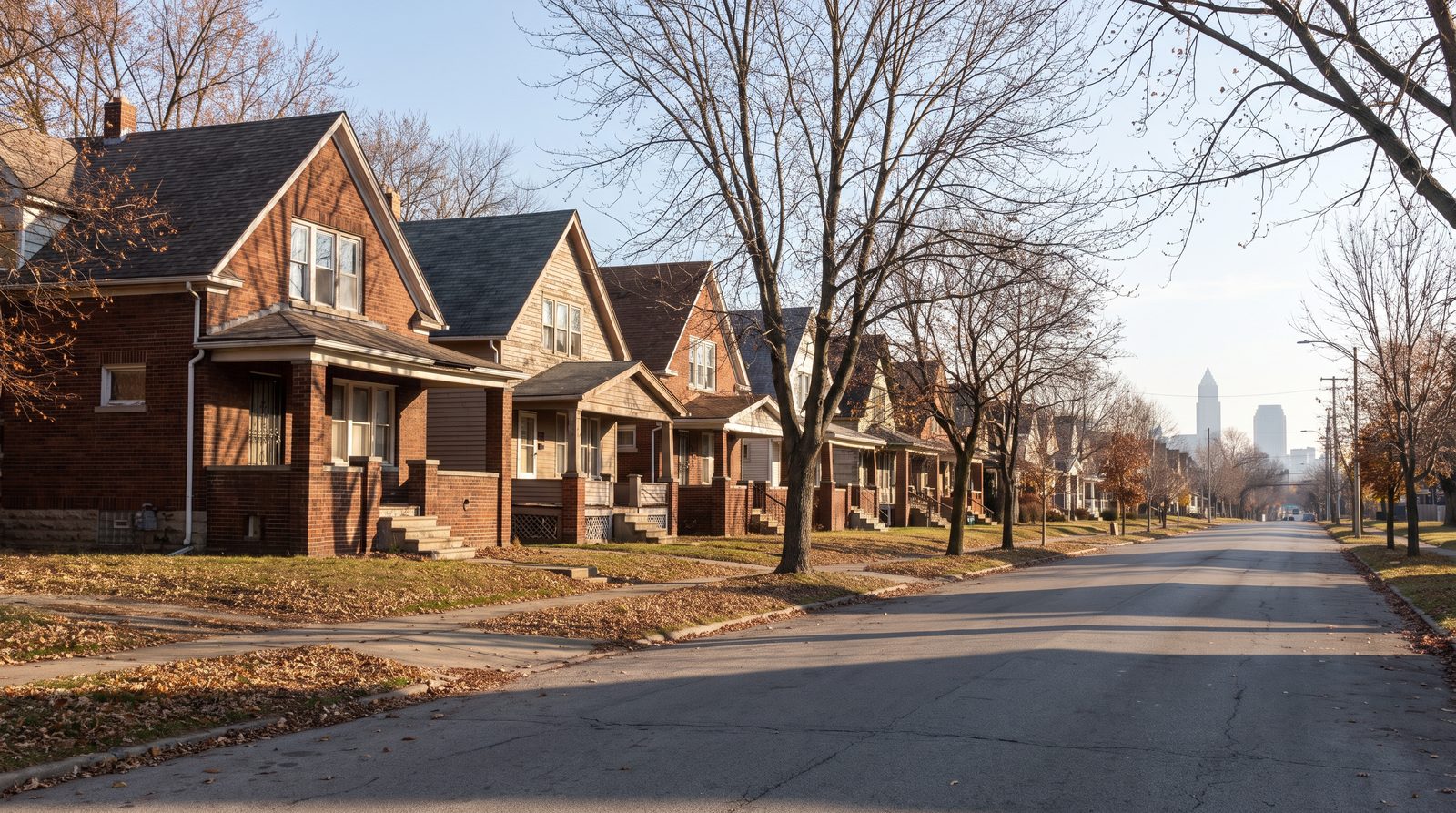
A residential street of older two-story houses in late autumn with orange traffic barrels along the curb and wooden survey stakes with pink ribbon in the tree lawn
In Ohio, an agency that wants your property must send a notice of intent to acquire, make a written good faith offer and give you its appraisal, all before it can go to court. You have at least ten days to consider the offer and you do not have to accept it. If you cannot agree, a court and a jury decide. You can hire your own appraiser and attorney at any point.
Eminent domain is not "condemned"
People mix these up. A house "condemned" by a city building department is about safety. Nothing is bought. Eminent domain is different: a public agency or certain utilities acquire private property for a public use and pay for it. In Ohio law, that process is called appropriation, under ORC Chapter 163. Our post on selling a condemned house covers the code-enforcement side.
Want a second number to compare?
Send us the address. A written cash offer is one more point of reference while you review an agency's offer with your advisers.
The steps before any court case
| Step | What the agency must do | Ohio law |
|---|---|---|
| Notice | Send a notice of intent to acquire at least 30 days before filing in court, in person or by certified mail | 163.04(A) |
| Offer | Make a written good faith offer, at least 30 days before filing | 163.04(B) |
| Appraisal | Get an appraisal and give you a copy at or before the first offer | 163.04(C) |
| Try to agree | Go to court only after it cannot reach an agreement with you | 163.04(D) |
| Your time | Give you at least ten days from receiving the offer to accept or reject | 163.041 |
From ORC 163.04 and 163.041. Some steps differ for owners who are unknown or cannot be found, and for appraisals under $10,000.

What the notice tells you
ORC 163.041 spells out the form the notice must substantially follow. It names the project and the property or easement needed. Then it lists your rights in plain terms:
- The agency must make a good faith effort to buy the property or easement.
- You do not have to accept the offer, and the agency does not have to agree to your demands.
- If you cannot agree, the agency may file suit in the county where the property is.
- You may get advice from an attorney, an appraiser or anyone else you choose.
- For most public agencies, you can object in writing within ten business days of receiving the notice.
- You will get a written offer and the appraisal, or a summary, that it is based on.
The notice form gives owners a right to object to the project's public purpose, necessity, blight designation or valuation in writing within ten business days of receiving the notice. This does not apply to private agencies or municipally owned public utilities. Read your notice closely and talk to an attorney early.
If you and the agency do not agree
The agency may file an appropriation case. According to the notice form, you may dispute whether the project is necessary and whether it is a public use, except in quick takes. You may dispute whether your property is blighted if that applies. And you may dispute whether the offer reflects fair market value.
After a trial, a jury decides the amount for the property taken, any damage caused by the taking and other damages the law allows. The notice warns that the award could be more or less than the agency's offer. You have the right to testify about the value of your property.
Fees, costs and mediation
The notice form explains two ways owners may recover attorney fees and costs. If a jury awards significantly more than the good faith offer, revised offer, or offer after an appraisal exchange, you may recover fees, costs and expenses, subject to limits in the law. If the court decides the project is not necessary or not a public use, the judge awards your full attorney fees, costs and expenses.
You can also ask for nonbinding mediation on value. The written request is due within ten business days after you file your answer to the agency's petition. If mediation does not settle it, the case goes to a jury trial on value.
What to do when the letter arrives
Note the dates
Read the appraisal
Consider your own appraisal
Ask questions in writing
Talk to an attorney
Common situations
The agency needs only a strip of your yard
The notice may cover an easement or part of the property, not the whole lot. The jury's award can include damage caused by the taking, not only the land itself. Ask how the project changes access, parking or the use of what remains.
The offer feels low
You do not have to accept it. The agency may revise its offer if it learns of conditions it could not reasonably have found earlier, or after the two sides exchange appraisals. An independent appraisal gives you something concrete to discuss.
You own the house with a sibling
Under ORC 163.04(C), the agency must give a copy of the appraisal to each owner, or to each owner's guardian or trustee. Make sure every owner gets the papers, and decide together how you will respond.
The project will block your driveway for months
ORC 163.04(E) says an agency may appropriate property for projects that will disrupt traffic or block access only after it makes reasonable efforts to plan the project to limit those effects. Ask the agency how it plans to keep access open. This rule does not apply to projects started under Title LV of the Revised Code.
Know your net proceeds
Know your net proceeds
If you sell to the agency, ask what costs, if any, come out of your proceeds. Compare what the agency offers with what you might net another way. With made-up numbers, a $150,000 house listed with a 6% commission pays $9,000 to agents, plus closing and holding costs. A direct sale has no commission, but the offer is often lower than a top listing price. If an agency has sent notice, talk to your attorney before choosing any path.
Your six options
| Option | How it fits | What to weigh |
|---|---|---|
| Keep it | If no agency has sent notice, nothing changes | Once notice arrives, the process may continue |
| Repair it | Repairs may or may not affect an appraisal | Ask your appraiser first |
| Rent it out | Ask how a lease fits the process | Talk to your attorney |
| List with an agent | Commissions often run 5.5% to 6% | Ask your attorney what to tell buyers |
| Sell it yourself (FSBO) | No commission | You handle the questions |
| Sell direct for cash | As fast as 7 days, typically around 21 | The price is often lower than a listing |
If you have received a notice of intent to acquire, get legal advice before selling to anyone.
Compare your options with a written offer
We buy houses across Cleveland and Northeast Ohio as-is. A written number can help you and your attorney weigh the choices.
This article summarizes Ohio Revised Code 163.04 and 163.041 as we read them in November 2026. It is general information, not legal advice. We did not cover relocation assistance, quick-take procedures, tax effects or any specific project. Talk to an Ohio eminent domain attorney about your property.
Got a notice and want to talk it through?
Call or send us the address. We will explain how a direct sale works, and every decision stays with you and your attorney.
Frequently asked questions
The agency must give a notice of intent to acquire at least 30 days before it files a court petition. It must be delivered in person or by certified mail.
Yes. It must give you a written good faith offer, with the notice or after it, and not less than 30 days before it files a petition.
Yes. The agency must get an appraisal and give you a copy at or before its first offer. If the appraisal shows a value under $10,000, a summary is enough.
The notice must state a number of days, at least ten, from the time you receive the offer. You are not required to accept it.
The notice form says you may dispute whether the project is necessary and a public use (except in quick takes), whether your property is blighted if that applies, and whether the offer reflects fair market value.
Possibly. If a jury awards significantly more than the good faith offer, you may recover attorney fees, costs and expenses, subject to statutory limits. If the court finds the project is not necessary or not a public use, the judge awards full fees and costs.
You can ask for nonbinding mediation on the value of your property. The written request is due within ten business days after you file an answer to the agency's petition.
Find out what we would pay
Free, no obligation, and no pressure. If our number does not work for you, that is a perfectly fine answer.
Keep reading

Damaged & Condemned
How to Sell a Condemned House in Cleveland, Ohio
A condemnation is not a seizure — you still own it and can still sell it. What matters is the demolition bill, which becomes a lien on the land whether the house is there or not.
Liens, Taxes & Title
Property Value Too High? The Cuyahoga Board of Revision, Explained for Sellers
If you think the county values your house too high, Ohio lets you file a complaint with the Board of Revision. Here is how it works in Cuyahoga County, the deadline, and how a sale price can change your tax value.

Foreclosure & Hardship
What Happens If I Owe More on My Mortgage Than My Cleveland House Is Worth?
Being underwater is a problem with routes out of it. Ohio puts a two-year limit on a deficiency after a judicial sale — but not after a short sale.