Asbestos and Selling an Older Ohio House
If your house has cement shingle siding, wrapped basement pipes or old floor tiles, somebody has probably told you that you cannot sell until it is removed. That is usually wrong. Here is what the rules actually cover, the two exceptions that catch a lot of Cleveland houses, and the one duty that applies no matter what.
Weathered grey-green cement shingle siding on an older house, chipped at the edges with moss in the seams
For most Ohio homes, nothing has to be removed before you can sell. The demolition and renovation asbestos rules apply to a "facility", and both the federal and the Ohio definitions exclude residential buildings with four or fewer dwelling units. What does always apply is disclosure: if you know asbestos is there, you have to say so.
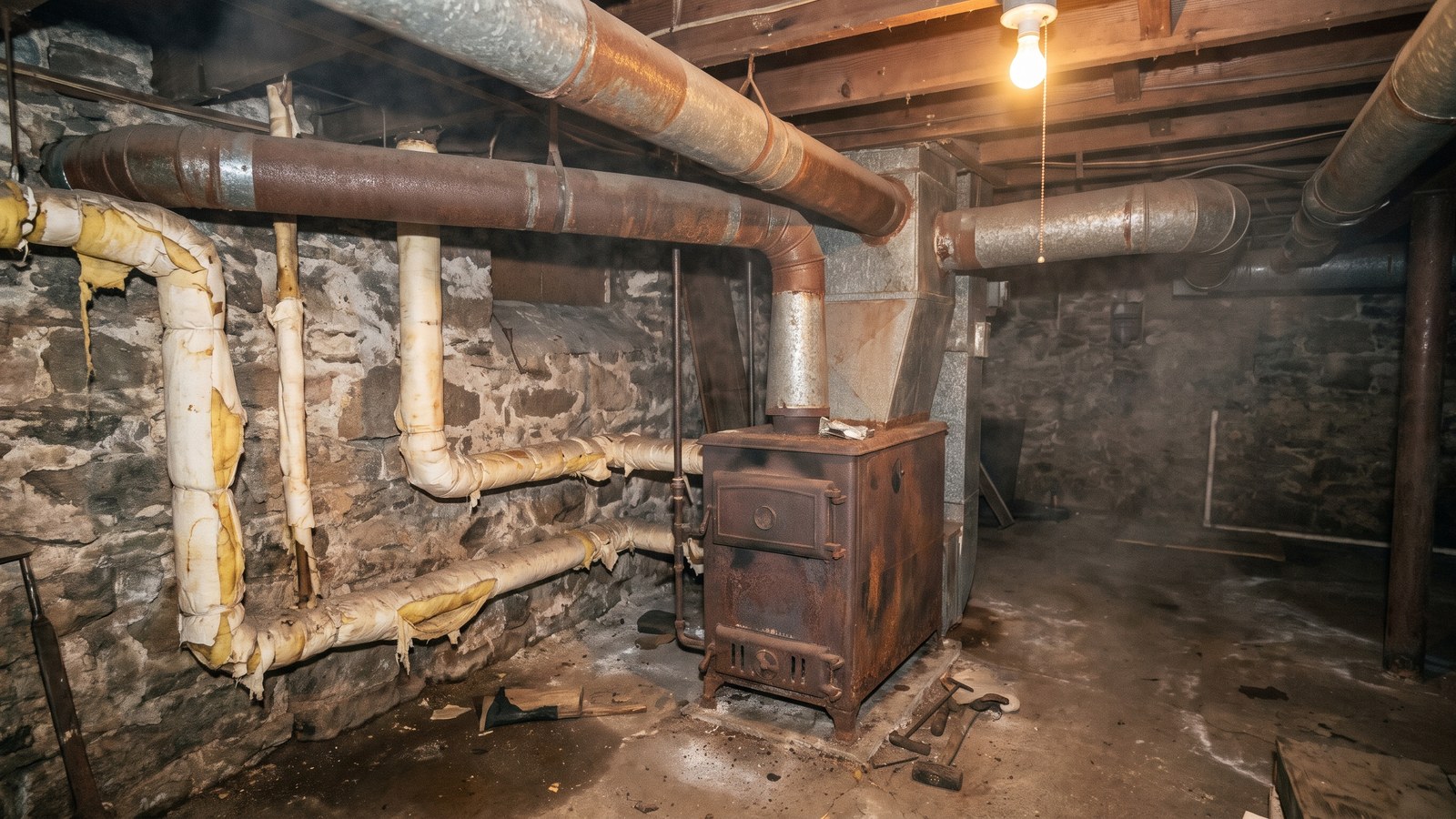
Cleveland built a lot of its housing when asbestos was ordinary building material. Cement shingle siding, wrap on basement heating pipes, nine-inch floor tiles, roofing felt, furnace insulation. If your house dates from before the late 1970s, some of it is probably there.
The advice people receive about this is unusually bad, in both directions. One version says you must have the house professionally abated before it can be sold. The other says none of it matters. Neither is right, and the difference between them is worth real money.
Friable, and why it is the word that matters
The regulations do not treat all asbestos the same. The dividing line is friability: material containing more than one per cent asbestos that, when dry, can be crumbled, pulverised or reduced to powder by hand pressure. That is the stuff that gets into the air.
- Friable — deteriorating pipe and boiler wrap is the textbook case. Crumbling, fibrous, and easy to disturb by touch.
- Category I non-friable — packings, gaskets, resilient floor covering and asphalt roofing products containing more than one per cent asbestos.
- Category II non-friable — anything else over one per cent that, when dry, cannot be crumbled by hand pressure. Cement shingle siding usually sits here.
That matters because non-friable material only becomes "regulated" when it is damaged enough to turn friable, or when it is about to be sanded, ground, cut or abraded — or, for Category II, when it has a high probability of being crumbled or powdered during demolition. Intact siding sitting on a wall is generally not the regulated category. Siding being smashed off with a hammer can be.
The rule that does not reach most houses
The demolition and renovation asbestos rules — federal and Ohio alike — apply to the owner or operator of work on a facility. And "facility" is a defined term that quietly excludes most homes. It covers institutional, commercial, public, industrial or residential structures, "but excluding residential buildings having four or fewer dwelling units".
Ohio did not write a stricter version. Its definition mirrors the federal one word for word on this point. So a single-family house, a Cleveland double, a triple and a fourplex all normally fall outside the rules that require inspection, notification and controlled work practices.
The two exceptions that catch Cleveland houses
Ohio added two sentences the federal definition does not have, and they matter here more than almost anywhere.
The first: a building containing a loft used as a dwelling is not considered a residential structure. The second is the one to watch — a building that was previously subject to the rule because of its prior use or function is not excluded, regardless of its current use or function.
Read that again with Cleveland in mind. Converted storefronts with the shop window bricked in. Former churches, schools, funeral homes and small factories turned into housing. Those buildings are homes now, but they were facilities then, and the rule says the exclusion does not come back. If your building was ever something other than a house, that is a question for Ohio EPA or a certified asbestos hazard evaluation specialist — not for a blog, including this one.
Not sure which side of the line your house sits on?
Tell us what the building is and what it used to be, and we will tell you what we think you are dealing with — including when the honest answer is that you need Ohio EPA or a certified specialist rather than a buyer. No cost, nothing to sign.
Ohio’s licensing rules, and the exemption that is not permission
Ohio runs a licensing and certification scheme for asbestos work under ORC Chapter 3710. It reaches contractors, specialists, workers, project designers and air-monitoring technicians. A licensed contractor has real obligations before a project starts: a written respiratory protection programme, a physician’s finding within the past year that each worker is physically capable of working in a respirator, and approved training.
Then comes the sentence most sellers have never seen. The definition of an "asbestos hazard abatement contractor" does not include "any individual who engages in an asbestos hazard abatement project in the individual’s own home." The licensing scheme does not reach a homeowner working on their own house.
We are telling you the carve-out exists because it is real and you are entitled to know it. We are not telling you to use it. The rules exempt you from needing a licence; they say nothing about whether disturbing the material is a good idea. Intact, undisturbed material is usually best left exactly as it is — and if you do decide work is needed, a licensed contractor is working to standards you would otherwise have to reproduce yourself.
The numbers the rules actually turn on
| Threshold | Figure | Source |
|---|---|---|
| Ohio "abatement activity" | More than 3 linear feet or 3 square feet of friable material | ORC 3710.01(B) |
| Ohio "abatement project" | More than 50 linear feet or 50 square feet | ORC 3710.01(D) |
| Ohio EPA notification and work practices, for a facility | At least 260 linear feet on pipes, or 160 square feet on other components | OAC 3745-20-02(B)(1) |
| Notice before demolition of a facility | At least ten working days | OAC 3745-20-03(A)(3)(a) |
These are regulatory triggers, not safety thresholds. Material below a threshold is not thereby harmless — it is simply below the point where a particular rule switches on.
The duty that survives all of it
Here is where the "none of it matters" version falls down. Ohio’s residential property disclosure form is required to cover the presence of hazardous materials or substances — and the statute names asbestos directly, alongside lead-based paint, urea-formaldehyde foam insulation and radon gas — together with any material defects within the actual knowledge of the transferor.
So the two questions are genuinely separate. Must I remove it? Usually no. Must I say what I know about it? Yes. Actual knowledge is the standard, which means you are not expected to test for what you do not know about — but you cannot unknow a survey you have already had done, or a contractor who already told you what is in the basement.
Want to know what it means for your number?
We will look at the house as it stands and give you a written offer with no repairs and no abatement asked of you. Then compare it against what a listed sale would net after costs. The comparison is the useful part, whichever way it points.
Your options, honestly
Keep it and leave it alone
Frequently the right answer. Intact, sealed material in good condition is generally not an emergency, and the rules do not require you to act.
Repair or encapsulate rather than remove
Sealing or covering damaged material is a recognised approach and is often less disruptive than removal. Get advice from someone certified before choosing between them.
Have it removed before selling
Worth it mainly when material is already deteriorating, or when a specific buyer or lender requires it. Get two written quotes from licensed Ohio contractors; do not budget against a number you read online.
Rent it out instead
Nothing about asbestos prevents this, but a landlord takes on responsibility for the condition of the property over time, and deteriorating material is a maintenance problem that only grows.
List it as it stands, and disclose
Entirely normal. Older Cleveland houses sell with asbestos in them all the time. Commissions in our area commonly run 5.5% to 6%, and a well-informed buyer prices it in rather than walking.
Sell direct for cash
Useful when the material is deteriorating and you do not want to manage the work, or when the building is one of the previously-subject ones and you would rather not navigate it. Not automatically the best net — compare it against listing.
We are not quoting you a price for a survey, for abatement or for disposal. The figures competing pages publish are not traceable to any source we can read, and a made-up number is worst precisely where you would rely on it. We also have not verified what Cleveland Building & Housing requires for a demolition permit, so we are not going to assert it — ask the city directly if demolition is on the table.
And the point worth saying plainly, given who is writing: asbestos is not a good reason to sell a house cheaply to anyone, us included. For most homes nothing has to be removed at all, which means it is rarely the emergency it gets presented as.
This describes federal and Ohio rules as we read them and is not legal, environmental or health advice. Whether a specific building is a "facility", and what any particular work requires, depends on facts we cannot see from here. Talk to Ohio EPA, a certified asbestos hazard evaluation specialist, or a licensed Ohio contractor before you act.
If you just want a straight read on the house
Call or text and describe what you have got. We will tell you where we think it lands — including if that means leaving it alone and listing it normally. No cost and no pressure.
Frequently asked questions
No law we can find requires it as a condition of selling. The demolition and renovation asbestos rules attach to a "facility", and both the federal and Ohio definitions of facility exclude residential buildings with four or fewer dwelling units. A single-family house, a Cleveland double, a triple or a fourplex is normally outside them. Your lender or your buyer may still ask for something, but that is a deal term, not a legal requirement.
Ohio’s licensing rules do not stop you — the definition of an asbestos hazard abatement contractor expressly excludes an individual working in their own home. But that is an exemption from licensing, not a statement that it is safe or sensible. Material that is intact and undisturbed is generally best left alone; disturbing it is what creates the problem.
Material containing more than one per cent asbestos that, when dry, can be crumbled, pulverised or reduced to powder by hand pressure. Old pipe and boiler wrap is the classic example. Cement siding and resilient floor tile are normally non-friable, which is why they are treated differently.
It can, and this catches people out. Ohio’s rule says a building that was previously subject to the rule because of its prior use or function is not excluded, regardless of its current use. A converted storefront, church or school that is a home today may still count as a facility. If your building was ever something else, ask Ohio EPA or a certified evaluation specialist rather than assuming.
Yes, to the extent you actually know. Ohio’s residential property disclosure form specifically covers the presence of hazardous materials including asbestos, and material defects within the actual knowledge of the transferor. Not being required to remove something is not permission to stay quiet about it.
Then it is worth checking carefully, because the demolition rules turn on whether the building is a facility. Where they do apply, an affected facility must be inspected by a certified asbestos hazard evaluation specialist before work starts, and notice must reach the director at least ten working days before demolition begins.
No. Both definitions expressly include a building containing condominiums, or individual dwelling units operated as a residential cooperative. The four-or-fewer exclusion is for residential buildings; a condominium building is named on the inside of the definition, not the outside.
We are not going to quote you a figure. The numbers competing pages publish for surveys, abatement and disposal are not traceable to any source we can read, and inventing one would be worse than useless when it is the number you might budget against. Get two written quotes from licensed Ohio contractors for your actual house.
Find out what we would pay
Free, no obligation, and no pressure. If our number does not work for you, that is a perfectly fine answer.
Keep reading
Why Sell As-Is
Selling a House Built Before 1978: The Lead Paint Rule
You do not have to test for lead, remove it, or fix it before selling. You do have to disclose what you know — and hiding it carries treble damages.

Inherited Property & Probate
Which Ohio Home Sales Are Exempt From the Disclosure Form?
Ohio law exempts fourteen kinds of transfer from the residential property disclosure form — including most estate sales and inherited houses you never lived in.

Damaged & Condemned
Can You Sell a House With Water Damage or Mold in Ohio?
Yes — and Ohio’s disclosure form has no mould box at all. What it does have is a catch-all that matters more, and it turns on what you actually know.