They Lived Out of State and Owned a House Here
Your mother lived in Florida or Arizona for the last fifteen years and still owned the house in Cleveland. The estate is being administered where she lived, and somebody has told you that Ohio needs its own case. That is broadly right — but there are two routes, not one, and which one is open to you turns on whether there was a will.
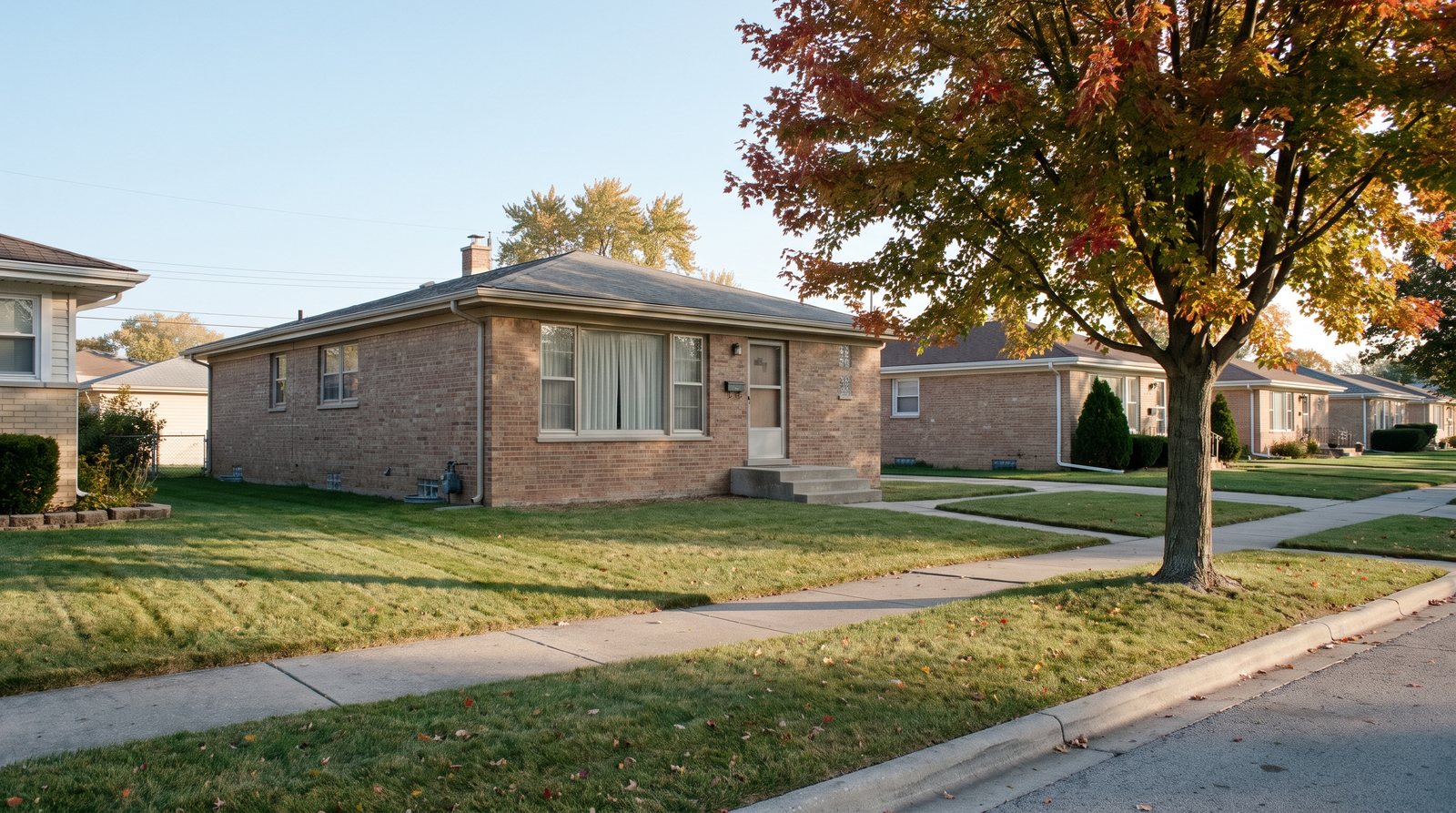
A modest brick ranch house with drawn curtains, an empty driveway and a leaf-covered lawn on an overcast autumn day
Ohio has two routes, not one. A full ancillary administration can be opened by any interested person in a county where the property sits — and the first one granted covers the whole state and shuts out every other Ohio court. Or, where letters were already granted where your parent lived and no ancillary case has begun here, you may simply file an authenticated copy of those letters in an Ohio probate court, which also lets you cut the creditor-claim window against the house down to thirty days or six months, whichever comes first. Whether you can act from out of state turns on one thing: whether there was a will.
This is one of the most common situations we see in Cleveland and it is badly served online. The parent moved south years ago, kept the house, and it is now sitting empty a long flight away while the estate is administered somewhere else entirely. Here is what Ohio actually requires.
We are a house-buying company, not a law firm. Everything below is quoted from the Ohio Revised Code so you can check the section named. Which route fits depends on the will, the debts and what the court where your parent lived has already done — that is a question for an Ohio probate lawyer, and it is worth one conversation before anything else.
Two courts, one house
The main estate belongs where the person lived. Ohio real property does not travel, so something has to happen here too. The section that opens that door is short and broader than people expect:
When a nonresident decedent leaves property in Ohio, ancillary administration proceedings may be had upon application of any interested person in any county in Ohio in which is located property of the decedent, or in which a debtor of such decedent resides. Such applicant may or may not be a creditor of the estate. The ancillary administration first granted shall extend to all the estate of the deceased within the state, and shall exclude the jurisdiction of any other court.
Three things in that. Any interested person may apply — it is not reserved to the family, and the statute says outright the applicant may or may not be a creditor. Any county where property is, which for most families means the county the house is in. And the last sentence is the one to notice: the first grant covers the whole state and excludes every other Ohio court. Where relatives are not of one mind, whoever files first has settled where this happens.

Whether you can handle it yourself turns on the will
This is the fact worth the whole page, because it decides whether an out-of-state family needs to find somebody local before anything can start. Ohio has two different residency rules and they point opposite ways.
| There was a will naming you | There was no will | |
|---|---|---|
| What you would be | Ancillary administrator, named or nominated in the will | An administrator |
| Residency rule | Appointed whether or not you live in Ohio | Shall be a resident of this state |
| If you are a nonresident | You must be related to the testator by blood or marriage, be a private or family trust company, or live in a state whose law allows the reverse | Not available — and an administrator is removed on proof they are no longer an Ohio resident |
| Can the court refuse you for living elsewhere? | Not solely on that ground, if you qualify | Residency is the ground |
| Who gets appointed instead | You, if you apply and qualify — the statute says the court shall appoint | A suitable person resident in the county, which may include a creditor |
Summarised from ORC 2109.21(A), 2109.21(B)(2) and 2129.08(A) and (B). The third row’s reciprocity test turns on the other state’s own statutes, which are not in the Ohio Revised Code and which we have not read — if that is the limb you are relying on, it is a question for a lawyer in both states.
Before any appointment, the will itself has to be put on the record here. An authenticated copy of the will of a person not domiciled in Ohio, executed and proved according to the laws of the state where they lived, may be admitted to record in the probate court of a county where part of the property sits — and once recorded, it is "as valid as wills made in this state". If the estate owns property in more than one Ohio county, a certified copy with the order annexed can be filed in the others.
Carrying a house you cannot yet sell?
While the paperwork catches up, the taxes, insurance and utilities keep running. If it would help to know roughly what the house is worth as it stands, we will put a figure in writing at no cost — useful for the estate file whether or not you ever sell it to us.
The shorter route most articles never mention
A full ancillary case is not always necessary. There is a second route, and it is the part page one leaves out entirely. Where letters of administration or letters testamentary have already been granted in the state where your parent lived, and no ancillary proceedings have been commenced in Ohio, the person holding those letters may file an authenticated copy of them in the probate court of any Ohio county where the decedent’s real property is located.
That filing does something useful beyond announcing itself. It lets you accelerate the bar against creditor claims attaching to the Ohio house. The written notice has to carry four things:
- The decedent identified by name.
- The date of death.
- The court identified, and its mailing address.
- A statement that any claims must be presented to the court within the earlier of thirty days after the claimant receives the notice, or six months after the date of death.
A claim not presented inside that window "is forever barred as a possible lien upon the real property of the decedent in this state". For a family trying to hand a buyer clean title on a house two thousand miles away, that sentence is the practical point of the whole exercise. The statute also says that if a claim is filed and remains unpaid after reasonable notice to the nonresident executor, ancillary proceedings may then be had forthwith — so this route does not permanently avoid the other one.
Who may actually sign the deed
Once an ancillary administrator is appointed for a decedent who left a will, the selling power is set out directly: they "may sell and convey the real and personal property by virtue of the will as executors or administrators with the will annexed may do".
And "by virtue of the will" carries real weight, because of a separate section. Where a fiduciary is authorised by the will to sell real property, no order is required from the probate court to proceed with the sale, and the power authorises a sale for any purpose the fiduciary considers to be in the best interest of the estate — unless the will expressly limits it. So a will with a power of sale can make an out-of-state family’s Ohio problem considerably smaller than they feared.
Your options, honestly
One thing comes before all the others, and it is not a disposal decision.
- Get the authority straight first. Nobody can sell anything until somebody has the power to sign. An hour with an Ohio probate lawyer, establishing which of the two routes fits, is the step that unblocks every other one. We cannot buy a house from somebody who does not yet have authority to sell it, and we would not try.
- Keep it. If the estate can carry the taxes, insurance and upkeep and there is no hurry, there is no rule requiring a decision this year.
- Repair and list. Usually the highest gross, and usually the hardest to manage from another state — someone has to let contractors in. Ohio commissions generally run 5.5% to 6%.
- Rent it. Income rather than a lump sum, plus landlord obligations discharged at a distance, which is its own job.
- List it as-is. Fewer site visits, a narrower buyer pool, the same fiduciary paperwork at closing.
- Sell direct. No commissions, no repairs, no clearing the house out, closing as fast as 7 days once the authority and title work are clean and typically around 21. The price is below retail, and a fiduciary has to be able to explain that trade to the beneficiaries.
Distance changes the arithmetic. A listed sale at a higher price carries commission, concessions, repairs and every month of taxes, insurance and utilities on an empty house — plus flights, or somebody local you are paying to stand in. A direct sale carries none of those and a lower price. Run both, with the travel in the column where it belongs. Sometimes listing still wins, and we would rather say so.
Want the two columns side by side?
Send us the address and we will set our offer against a realistic listed-sale net with the deductions itemised, including the months of carrying cost. Several families have used it to decide to list locally instead, which is a perfectly good use of it.
Where this leaves you
Three things, in order. Find out whether there is a will, because that single fact decides whether you can act from where you live or need an Ohio resident appointed. Ask a probate lawyer whether the shorter route under the authenticated-letters section is open, because it is genuinely less work and page one will not have mentioned it. And if relatives disagree about any of this, remember that among Ohio courts the first grant of ancillary administration settles the venue for the entire state.
If there was no will at all, the intestacy rules decide who inherits before any of this matters, and we have written about those separately. If the house turns out to sit in a trust rather than the estate, that is a different mechanism again, with no court appointment involved.
When the house is the last thing left to deal with
We buy houses across Cleveland and Cuyahoga County in any condition, close through a title company, and handle everything from our end so nobody has to fly in. Reach out once the authority is settled — and if the better answer is a local agent, we will tell you that instead.
Frequently asked questions
Something has to happen here, but not always a full case. Where a nonresident decedent leaves property in Ohio, ancillary administration proceedings may be had on the application of any interested person, in any county where the property is located. Separately, where letters have already been granted in another state and no ancillary proceedings have begun here, the holder of those letters may simply file an authenticated copy of them in the probate court of an Ohio county where the real property sits.
Any county in which property of the decedent is located, or in which a debtor of the decedent lives. And the first one wins: the ancillary administration first granted extends to all of the decedent’s Ohio estate and excludes the jurisdiction of any other court. If relatives are in disagreement, that sentence matters.
It depends on whether there was a will, and most articles get this flatly wrong. An administrator — which is what you have when there is no will — shall be a resident of Ohio and is removed on proof that they are not. But an ancillary administrator named or nominated in a nonresident’s will is appointed whether or not they live here, provided a nonresident is related to the testator by blood or marriage, is a private or family trust company, or lives in a state whose own law allows the reverse.
Not on that ground alone, if you qualify. The statute says the court shall not refuse to appoint, and shall not remove, a qualifying nonresident named or nominated in the will as ancillary administrator solely because the person is not a resident of this state. The court may require assurances about keeping assets in the county until distribution.
An authenticated copy of a will of a person not domiciled in Ohio, executed and proved according to the laws of the state where they lived, may be admitted to record in the probate court of a county where part of the property is situated. Once recorded it is as valid as a will made in Ohio, and a certified copy can then be filed in any other Ohio county where property sits.
An ancillary administrator acting as to the Ohio estate of a decedent who left a will may sell and convey the real and personal property by virtue of the will, in the same way an executor or administrator with the will annexed may. And where a will authorises the sale, no order is required from the probate court to proceed with it.
Filing the authenticated letters from the other state in an Ohio probate court, without opening a full ancillary case. That filing also lets you cut short the period in which creditors can attach the Ohio real property, by sending a written notice with the required details.
The notice must identify the decedent, state the date of death, identify the court and its mailing address, and tell the claimant that claims must be presented within the earlier of thirty days after they receive the notice or six months after the date of death. A claim not presented in that window is forever barred as a possible lien upon the decedent’s Ohio real property.
No. We buy houses; we are not a law firm. Everything here is quoted from the Ohio Revised Code so you can check the section named. Which route fits a particular estate depends on the will, the debts and what the domiciliary court has already done, and that is a question for an Ohio probate lawyer.
Find out what we would pay
Free, no obligation, and no pressure. If our number does not work for you, that is a perfectly fine answer.
Keep reading

Inherited Property & Probate
What Happens to a House When Someone Dies Without a Will in Ohio?
Ohio law decides who inherits, and it is not always the spouse. Here is the order it follows, and what it actually takes before anyone can sell the house.
Inherited Property & Probate
Selling an Ohio House That Is Held in a Trust
A trustee can usually sell without going to court, and does not have to hand over the whole trust to do it. One recording rule changed in June 2026 and most of what you will read online has not caught up.

Inherited Property & Probate
Can Siblings Sell an Inherited House if Everyone Doesn't Agree?
Nobody is trapped. Ohio law lets any co-owner compel a partition — and it gives whoever wants to keep the house a chance to buy it at the appraised value first.